
Electric bike charging should be planned around the approved battery and charger supplied for the bicycle. Before choosing a model, check where charging will happen, how the battery is accessed and whether the charging window fits the rider’s daily routine.
This guide covers the questions riders and dealers should ask about charging an electric bicycle. The operating instructions for the actual battery and charger remain the reference for connection order, temperature limits, indicators and maintenance.
01 / Confirm the battery and charger match
Use the charger supplied with or specifically recommended by the bicycle manufacturer. A plug that fits is not proof of compatibility. The U.S. Consumer Product Safety Commission’s charger guidance explains why a mismatched charger can create a fire hazard.
For a purchasing brief, request the battery model, chemistry, nominal voltage and capacity, together with the approved charger reference, output specification, mains input and destination plug. Keep that information as a matched set. If the original charger is lost or damaged, ask the supplier for an approved replacement instead of selecting one by connector shape or voltage label alone.
For dealers stocking several bicycles, label each approved charger reference clearly in the service records. Staff should be able to identify the correct match without relying on memory or the appearance of the charger casing.
02 / Plan a suitable charging location
Charge while present and awake, and follow the manufacturer’s instructions. Keep the charging area clear of combustible materials and escape routes. The CPSC micromobility safety guidance advises against charging while sleeping or away from home.
Check whether the intended parking place has suitable charging access. If it does not, ask whether the battery is designed to be removed and assess its weight and handling on the sample. Follow the specified removal and refitting procedure; do not assume that every frame-mounted battery is user-removable.
Keep the battery, charger and connections dry, and follow the charging temperature limits in the actual manual. Bosch’s battery-care guidance also emphasizes a dry charging area and room-temperature charging where possible. Its system-specific limits should not be treated as the specifications for a FALCON battery.
03 / Understand what affects charging time
Charging time depends on the battery’s starting charge level, capacity, approved charger and operating conditions. Ask for the estimated time for the specific battery-and-charger combination, including the starting and finishing charge levels used for that estimate.
A higher-capacity battery may need a different charging window from a smaller pack. Do not choose a higher-current charger to shorten the wait unless the manufacturer approves it for that battery. Charging behavior near completion also means that a simple capacity calculation is not a reliable promise of total charging time.
Compare the charging window with actual use. A rider who returns home well before the next journey has a different requirement from a bicycle used for repeated trips during the day. Record those operating needs before asking the supplier to propose a configuration.
04 / Check battery access on the bicycle sample
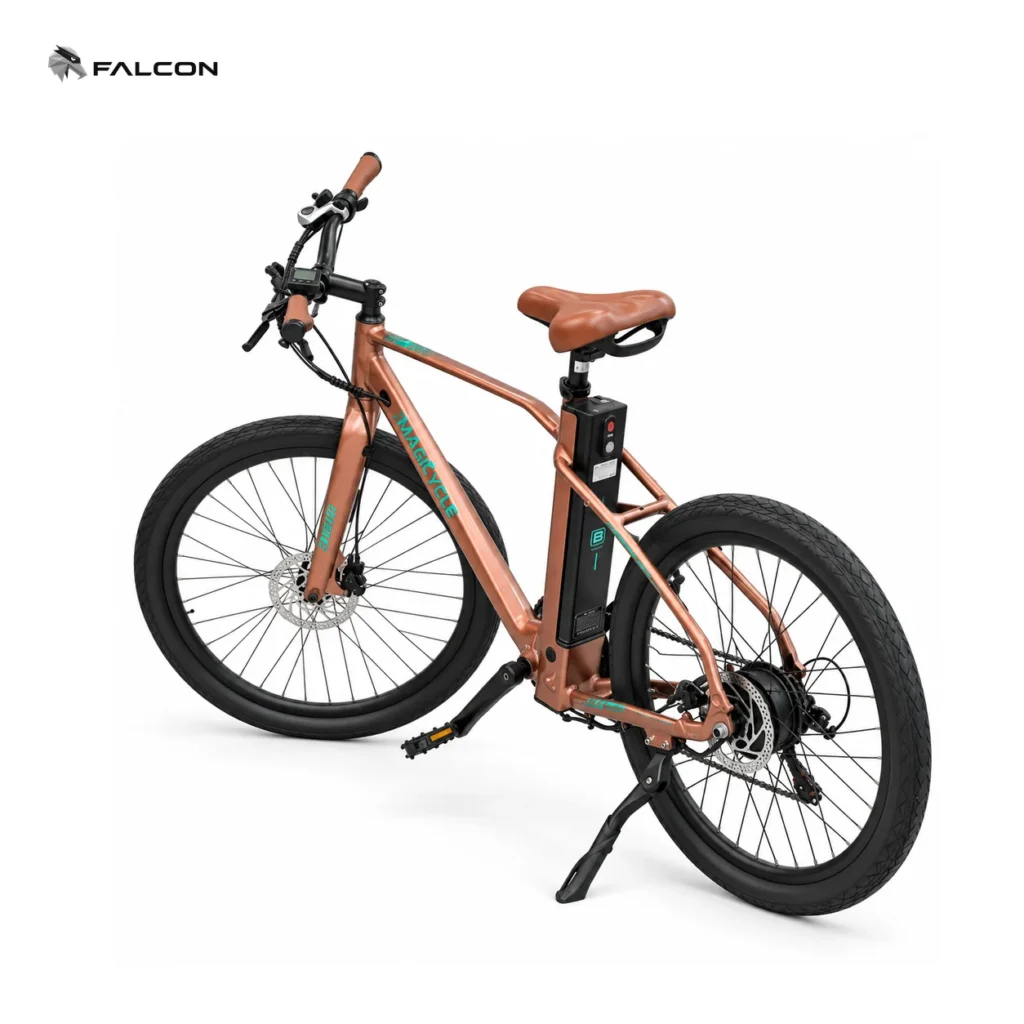
The FALCON ZR-CP017 electric bicycle provides one platform for a sample discussion. Ask the team to demonstrate battery access, the charge-port location and the approved charging procedure for the proposed build. A catalog photo does not establish the removal procedure or charger specification.
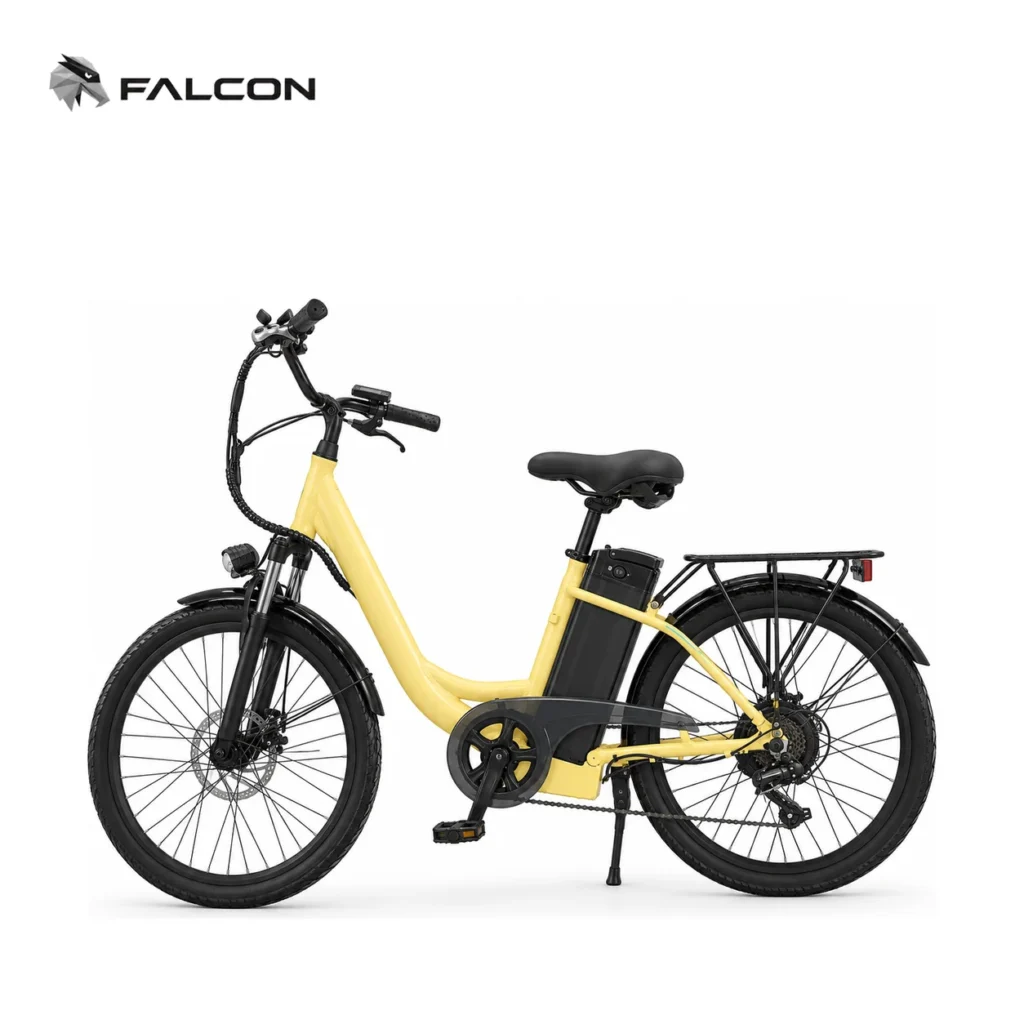
The ZR-CP014 commuter bicycle is another model to assess against a daily charging routine. Check where the bicycle will stand, whether the charge port is accessible and how the cable can be placed without being trapped or creating a trip hazard.
Ask for the instructions and indicator meanings with the sample. Keep the battery and charger identifiers in the inspection record so the demonstrated setup can be matched to the production order.
05 / Prepare charging instructions for handover
| Information | What the dealer should confirm |
|---|---|
| Matched equipment | Battery and approved charger model references for the bicycle. |
| Connection procedure | The sequence and precautions stated in the supplied manual. |
| Charging window | Estimated time and the conditions behind it. |
| Indicators | Normal charging, completion and fault indications. |
| Replacement support | How to obtain an approved charger or battery and report an issue. |
Stop using damaged equipment and contact the supplier or a qualified service provider. Do not open or modify the battery or charger. Record the model references and describe any indicator or fault message when requesting support.
06 / Electric bike charging questions
Can I use one charger for several electric bikes?
Only when the manufacturer explicitly confirms that charger is compatible with each battery. Similar plugs and nominal voltage labels are insufficient.
Can a larger battery be charged in the same time?
Ask for the estimate for the approved combination. Capacity, starting charge and charger characteristics affect the charging window; do not assume two packs behave identically.
Ask FALCON about an electric bicycle battery-and-charger configuration with your model, destination and charging routine. For choosing a platform, read the EV bicycle comparison guide; for quotation inclusions, see the electric bicycle cost guide.