
Starting an electric two-wheeler assembly plant can be a practical way to build a local mobility business. Instead of manufacturing every component, an entrepreneur can develop an operation around selected vehicle platforms, organized assembly and dependable after-sales support. The opportunity depends on more than market demand: the factory needs a realistic investment budget, consistent product quality and customers who will purchase its output.
This guide explains the market opportunity, factory setup costs, profitability calculations and operating priorities for an electric bike assembly factory or electric scooter assembly plant. All financial examples are in US dollars.
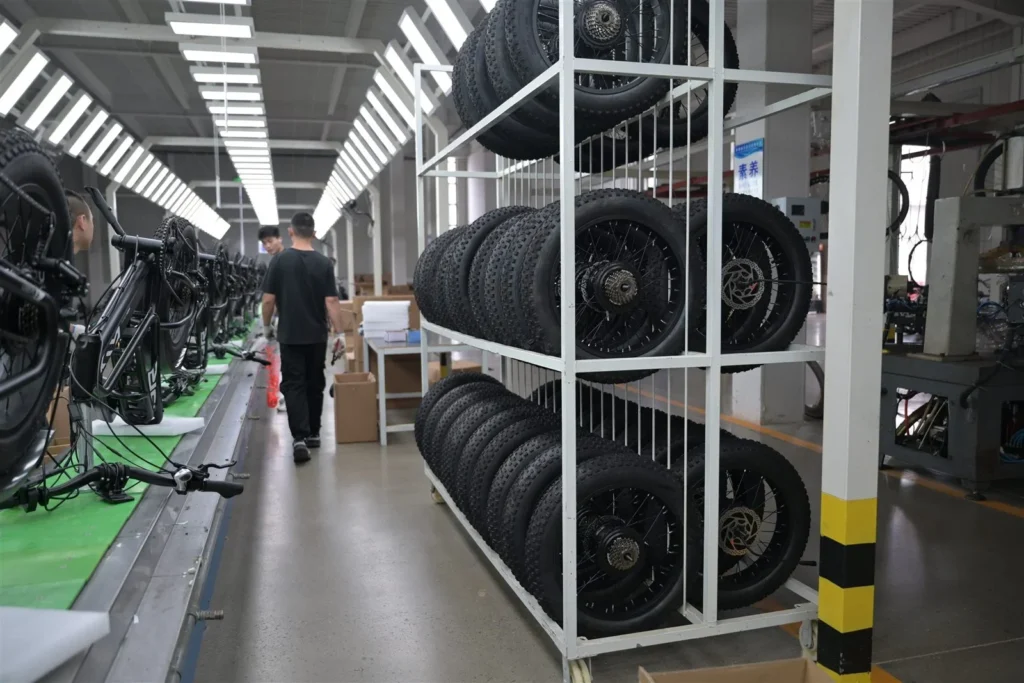
01 / Market demand creates the starting point
Electric mobility already serves a substantial customer base. In July 2025, China’s Ministry of Industry and Information Technology reported approximately 380 million electric bicycles in use. This is an installed-fleet estimate, not annual demand or a forecast of new factory orders.
For another part of the industry, the IEA reports almost 10 million electric two-wheeler sales worldwide in 2025, up 15% year on year. Its definition excludes electric-assisted bicycles and low-speed electric scooters, so these figures should not be combined with China’s electric-bicycle fleet count.
For a new assembly business, investigate three customer groups: commuters buying through dealers, delivery operators purchasing work vehicles, and local brands seeking a production partner. In smaller cities and regional markets, test purchasing budgets and service needs directly rather than assuming demand grows at the same rate everywhere.
Local assembly is worth investigating when it can improve product availability, configuration choices or customer support. Before leasing a building, obtain dealer feedback, evaluate sample vehicles and estimate monthly purchases. Treat policy incentives or tariff savings as items to verify locally, not automatic benefits of assembling vehicles in the destination country.
02 / Understand the cost of an electric two-wheeler assembly plant
Define the assembly scope first
For this planning example, the factory receives finished frames, motors, controllers, complete battery packs and other components. Its work covers vehicle assembly, adjustment, inspection and packing. It does not fabricate frames, paint bodywork or manufacture battery packs from cells.
Discuss SKD (semi-knocked-down) and CKD (completely knocked-down) supply options with the supplier, but agree on the exact packing list and work required locally. The label alone is not a production plan or a customs classification. For CKD electric vehicle assembly, document the delivered kit condition, local tasks and inspection responsibilities before ordering.
Under the scope above, laser cutting machines and robotic welding cells are not part of the initial equipment list. Adding frame manufacturing or battery-pack production would require a separate engineering, safety and investment assessment.
Premises and production layout
Use an 800–1,000 m² rented facility as a starting point for a layout study, not a universal minimum. Check delivery access, electrical capacity, permitted industrial use and the space needed for incoming goods, assembly, inspection, rework and finished vehicles. Have qualified local specialists assess battery storage, charging areas and fire-safety arrangements.
The example below assumes rent of $2,000 per month, equivalent to $24,000 annually, plus a refundable three-month deposit. This is a modeling assumption, not a property-market quotation. Monthly rent is included in operating costs; the startup table includes the deposit separately.
Equipment and startup cash allocation
Plan the equipment around the approved process: workstations or an appropriate conveyor, assembly fixtures, calibrated torque tools, lifting aids, material racks and model-specific inspection equipment. Specify electrical-function, braking and final-vehicle checks with the technical team. Begin with a line sized for validated demand rather than automatically installing two lines.
The U.S. Small Business Administration recommends separating one-time expenses from monthly expenses. The following allocation applies that distinction to an illustrative assembly project.
| Budget item | Illustrative allocation (USD) | Assumption |
|---|---|---|
| Refundable premises deposit | $6,000 | Three months at $2,000 |
| Facility preparation and utilities setup | $18,000 | Adaptation of an existing suitable building |
| Assembly equipment, fixtures and tools | $28,000 | Final assembly only |
| Inspection and testing equipment | $12,000 | To be specified for the selected models |
| Pre-opening preparation | $10,000 | Provisional allowance for samples, training and approval planning |
| Opening component inventory | $132,000 | 300 complete vehicle kits at an assumed landed cost of $440 each |
| Three-month fixed operating reserve | $54,000 | $18,000 per month |
| Contingency | $20,000 | Unallocated planning reserve |
| Total illustrative cash allocation | $280,000 | Not a supplier quotation or minimum investment |
These figures are newly constructed planning assumptions, not a currency conversion of a supplier quote. Replace every allowance with local quotations. Land purchase, new-building construction, frame fabrication and battery-pack manufacturing are excluded. Formal testing and approval costs must be established separately; the provisional allowance is not an assurance that those costs are covered.
Working capital and staffing
The assumed $18,000 monthly fixed budget comprises $12,000 for permanent payroll, $2,000 for rent and $4,000 for baseline utilities, insurance, administration and sales overhead. Set staffing from measured assembly time and required output rather than adopting a fixed headcount.
Three months of overhead is not three months of component supply. The opening inventory covers 300 vehicles only. Longer replenishment lead times, customer credit, recoverable import taxes and additional stock may require substantially more funding. Build a month-by-month cash forecast covering at least the first year.
03 / Calculate profitability and payback realistically
Choose the revenue model
Consider wholesale sales to dealers, supply contracts with fleet operators or contract assembly for another brand. Price each model separately. When a customer owns the components and pays an assembly fee, the revenue and working-capital structure differ from purchasing kits and selling complete vehicles.
Understand the economics of each vehicle
The following example assumes the factory buys kits and sells a basic urban two-wheeler. It is not a FALCON product quotation, and the figures should not be applied to premium electric motorcycles.
| Per-vehicle assumption | USD |
|---|---|
| Net wholesale selling price, excluding sales tax | $550 |
| Landed component-kit cost, including the battery and charger | $440 |
| Variable consumables and packaging | $20 |
| Expected variable warranty and service cost | $10 |
| Total variable cost | $470 |
| Contribution per vehicle | $80 |
The landed-kit assumption includes inbound freight and nonrecoverable import charges. Payroll sits in the fixed budget and must not be added again here. The $80 contribution is not net profit or an accounting gross margin: it must first cover fixed expenses. Under IAS 2, inventory cost includes purchase costs, direct labor and production overhead; formal financial reporting therefore requires more than this simplified contribution calculation.
Assuming production equals sales, the following scenarios show the effect of monthly volume. They also assume unchanged prices and enough capacity to keep fixed costs constant across this range.
| Monthly units sold | Revenue (USD) | Total contribution (USD) | Operating surplus before depreciation, interest and tax (USD) |
|---|---|---|---|
| 200 | $110,000 | $16,000 | -$2,000 |
| 300 | $165,000 | $24,000 | $6,000 |
| 500 | $275,000 | $40,000 | $22,000 |
Separate monthly break-even from investment recovery
Using the SBA’s break-even formula, this model covers its stated monthly operating costs at $18,000 ÷ $80 = 225 vehicles sold per month. This excludes depreciation, financing and tax and is not full investment recovery.
Dividing $280,000 by the modeled monthly surpluses gives rough screening ratios of about 47 months at 300 sales and 13 months at 500 sales. These are not payback forecasts. Ramp-up losses, taxes, financing payments, replacement investment and extra inventory or receivables funding change the cash available to recover the investment.
Calculate actual payback from cumulative project cash flow. Likewise, a target of 2,000 vehicles per month requires a new assessment of staffing, line capacity, inventory and customer orders—not simply multiplying a per-unit margin by nameplate capacity.
Size the plant around demand you can validate, fund the complete operating cycle and calculate investment recovery from cash flow rather than gross profit.
04 / Build a competitive electric vehicle assembly business
Control the supply chain and specification
Maintain an approved bill of materials, supplier records and an incoming-inspection process. Record battery, motor, controller and charger references. Require review before substitutions so the vehicle assembled locally matches the configuration sold to customers.
Train the team and document quality checks
Use assembly instructions, defined torque requirements, electrical checks and final-inspection records. Train workers on the approved process rather than encouraging undocumented wiring or performance changes. Retain vehicle identification and component records to support fault investigation.
Confirm the requirements for the finished vehicle in its destination market. For example, the UK Vehicle Certification Agency explains that type approval includes conformity-of-production assessment, not just testing a sample. Component documentation should not be treated as blanket approval for a finished vehicle.
Develop sales channels before expanding capacity
Build the first product range around dealer demand, fleet requirements or documented online enquiries. Agree on pricing, payment terms and preparation responsibilities. Add models or a second line when repeat orders and production results justify the investment.
Make after-sales support part of the product
Prepare spare-parts lists, service instructions and a clear warranty process. Work with local repair partners where appropriate, and use fault reports to improve assembly and supplier control. Dependable support gives dealers a reason to reorder beyond the opening discount.
05 / Build your electric two-wheeler assembly project with FALCON
FALCON can assist businesses planning to establish a local electric two-wheeler assembly plant. We welcome enquiries from entrepreneurs, importers and distributors seeking to move from vehicle sourcing toward an organized local assembly operation.
Discuss your requirements with our team, including vehicle-platform selection, SKD or CKD supply planning, component sourcing, assembly-line preparation, technical guidance and after-sales arrangements. Branding, documentation and training needs can be included in the project discussion. The available services, delivery method, responsibilities and fees are confirmed in the agreed proposal.
Local premises, permits, product approvals and staffing must be planned with the responsible local parties. FALCON’s assistance should be defined around your project rather than assumed to include every construction or regulatory task.
Contact FALCON to discuss your electric two-wheeler assembly factory. Share your country, intended vehicle types, target monthly output, available facility space, investment budget and proposed launch schedule. These details provide the starting point for a practical product-supply and assembly-support proposal.